How To Choose Stackable Pans For An Induction Hob
A practical step-by-step guide to how to choose stackable pans for an induction hob, including preparation, instructions, common issues, tips, and next steps.
How To Choose Stackable Pans For An Induction Hob
Choosing stackable pans for an induction hob requires balancing space-saving design with magnetic compatibility. This guide walks you through verifying materials, assessing stacking mechanisms, and matching pans to your hob for efficient and organized cooking.
Fast Answer
- Check for the induction symbol or test the base with a magnet; if it sticks firmly, the pan is compatible.
- Prioritize sets with removable handles and a nesting design to maximize cabinet space and prevent scratches.
Before You Start
- Measure your cabinet or drawer height and width to ensure the stacked set will fit comfortably.
- Consult your induction hob's manual for recommended minimum and maximum pan base diameters.
- Define your primary cooking needs: are you searing, simmering, or frying most often?
- Consider that durable, high-quality cookware is often a long-term investment for your kitchen.
Step-by-Step Instructions
Confirm Material Compatibility
The fundamental principle of an induction hob is its use of electromagnetism to generate heat directly within the cookware. This process only works with ferromagnetic materials, meaning pans that a magnet will stick to. Before considering any other feature, your first action must be to confirm this compatibility. When shopping in a physical store, carry a small magnet with you. For online purchases, carefully read the product specifications for explicit mentions of 'induction compatible' or look for the universal induction symbol, which resembles a coil of wire. The practical check is simple: place your magnet against the bottom of the pan. It should stick strongly and flatly across the entire base, not just weakly in one spot. This check is crucial because a weak magnetic connection leads to inefficient energy transfer, slow heating, and potential buzzing noises, defeating the primary advantages of your induction hob.
Assess the Space-Saving Design
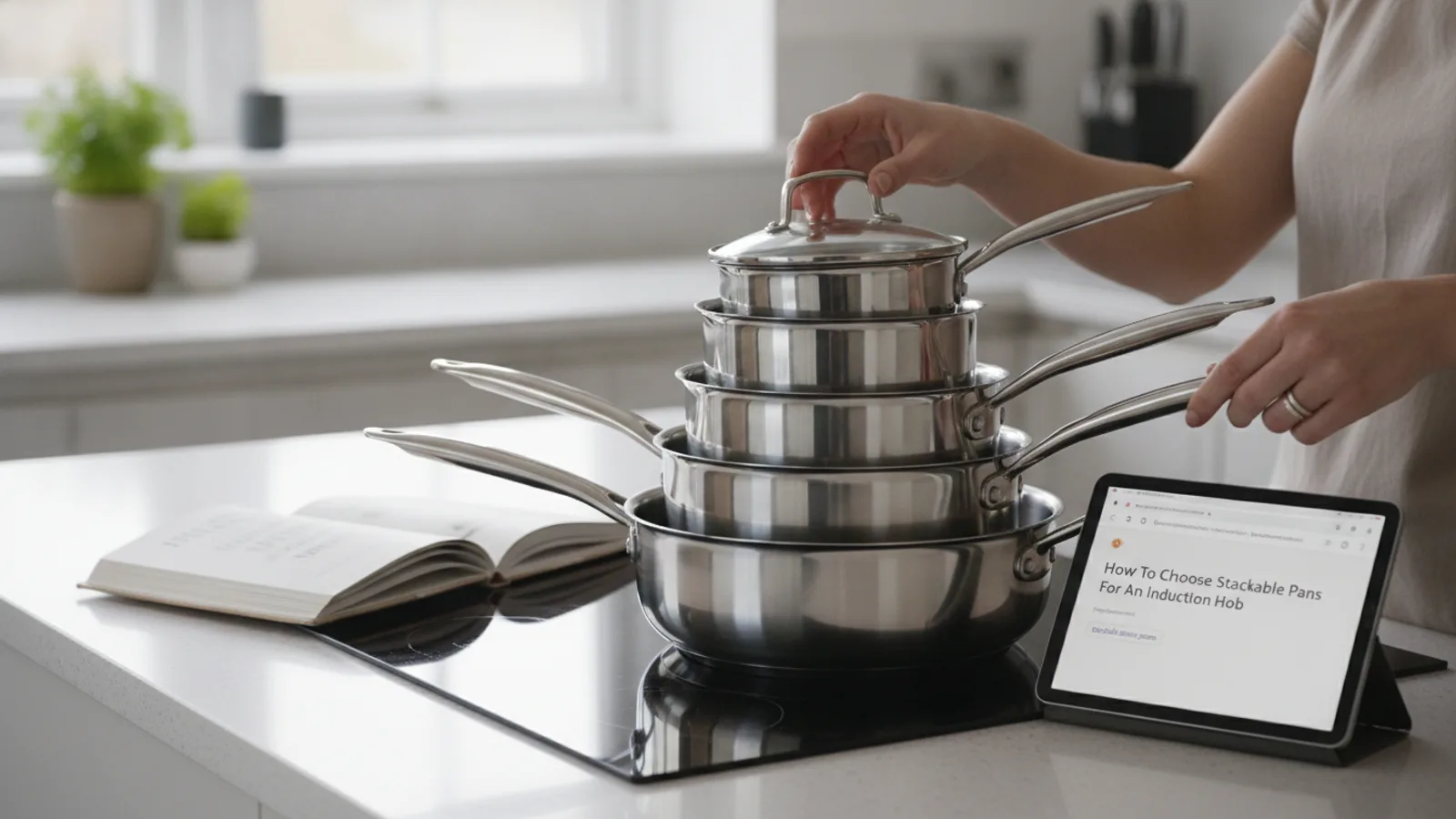
The primary appeal of stackable pans is their ability to reduce clutter and save valuable kitchen storage space. Evaluate the specific design intended for compact storage. The most effective systems typically feature a single, detachable handle that clicks securely onto any pan or pot in the set. Another design uses very low-profile, integrated handles that allow the pans to nest deeply within one another. Your action is to analyze how the pieces fit together. If possible, handle the set in a store to feel the handle mechanism and stack the pans yourself. The check is to stack the entire set and assess its stability and overall height. Does it wobble? Does it fit your intended drawer or cabinet? This evaluation matters because a poorly designed stacking system can be unstable, awkward to use, and might not save as much space as you expect, undermining the main reason for your purchase.
Examine the Pan's Base
An induction hob's glass-ceramic surface is perfectly flat, and for optimal performance, the base of your pan must be too. A thick, heavy, and completely flat base ensures maximum contact with the hob's surface, which is essential for uniform heat distribution. Warped or thin bases can create hot spots, causing food to cook unevenly or burn, and can also lead to annoying rattling or vibrating sounds during use. Your action here is to inspect the pan's base before buying. Place it on a known flat surface, like a countertop, and try to rock it. A practical check involves pressing down on opposite edges of the pan's rim; there should be no wobble or spin. This check is vital because a warped pan will not heat efficiently, will waste energy, and can even permanently damage the hob's surface over time from concentrated heat and vibration. A solid base is a hallmark of quality cookware.
Analyze the Cookware Material
The material of your cookware directly impacts its performance, durability, and maintenance requirements. For induction, the most common materials are magnetic stainless steel and enameled or bare cast iron. Magnetic stainless steel is durable, non-reactive, and relatively easy to clean. Cast iron offers superior heat retention and evenness but is heavier and requires careful seasoning and maintenance. Some aluminum or copper pans are made induction-compatible by bonding a steel plate to the bottom. Your action is to weigh the pros and cons of each material against your cooking style. The practical check is to read long-term reviews focusing on how the material holds up to daily use, including resistance to warping, scratching, and staining. This is important because the material determines not only how well the pan cooks but also how long your investment will last before needing replacement. Look for multi-ply construction for better heat conduction.
Match Pan Diameters to Hob Zones
Induction hobs work most efficiently when the pan's magnetic base closely matches the size of the cooking zone, or 'ring,' you are using. If the pan is much smaller than the ring, the hob may not detect it or may waste energy heating the area around it. If the pan is significantly larger, the edges outside the ring will not heat effectively, leading to uneven cooking where the center is hot and the perimeter is cool. Your primary action is to measure the diameters of the cooking zones on your hob (they are usually marked with circles) and compare them to the base diameters listed in the pan set's specifications. The check is to ensure that the set provides pans that are a good match for your most frequently used hob zones, especially your main large and small burners. This matters for energy efficiency and cooking performance, ensuring you get consistent results every time you cook.
Review Handles, Lids, and Ergonomics
Beyond the core construction, the ergonomics of handles and lids significantly affect the daily usability of your cookware. For stackable sets with removable handles, the locking mechanism is paramount. It must be easy to operate with one hand yet create a completely secure, wobble-free connection. Your action is to test this mechanism repeatedly. Attach and detach the handle, lift the heaviest pan in the set with it, and give it a gentle shake. For the lids, check if they are oven-safe, have steam vents to prevent boil-overs, and fit snugly. The practical check is to feel the handle's grip and the overall balance of the pan when lifted. Is it comfortable? Does it feel secure? This check is critical for safety; a failing handle or a poorly balanced pot can lead to dangerous spills and burns. A well-designed handle and versatile lids elevate a pan set from functional to enjoyable to use.
Quick Reference
| Situation | Action | Why it helps |
|---|---|---|
| Unsure if a pan is induction-ready | Hold a common refrigerator magnet to the bottom of the pan. If the magnet sticks firmly, the pan is compatible. | Induction hobs use a magnetic field to generate heat directly in the pan, so a magnetic base is essential for the cooking process to work. |
| Pans are scratching each other | Place a paper towel, a cloth pan protector, or a thin silicone mat between each pan when stacking them. | This creates a soft barrier that prevents the non-stick or polished surfaces from being abraded by the rougher base of the pan stacked above it. |
| Pan heats unevenly on the hob | Ensure the pan's base diameter is closely matched to the cooking zone's marking on the hob and that the base is perfectly flat. | A flat base with proper surface contact ensures the magnetic field is distributed evenly, preventing hot spots and promoting efficient heating. |
Common Issues
- My new pans make a buzzing sound.: This is often normal, caused by vibrations from high-frequency energy. Lowering the power setting can reduce it. If it's very loud, it could indicate a poorly bonded base; check with the manufacturer.
- The non-stick coating is peeling.: Avoid using metal utensils and abrasive scrubbers. Always stack pans with protectors in between. Once a coating is significantly damaged, it is best to discontinue use of the pan for food safety reasons.
- The removable handle feels loose.: Immediately stop using the pan with that handle. Check the locking mechanism for food debris. Consult the manufacturer's instructions for proper attachment or to see if a replacement part is available.
Advanced Tips
- Look for sets where the pans and lids are oven-safe, as this maximizes their utility and allows for recipes that start on the hob and finish in the oven.
- Consider the weight. While heavier cast iron or multi-ply pans retain heat better, ensure they are comfortable for you to lift and maneuver, especially when full.
- For multi-ply cookware, check if the conductive layers extend up the sides of the pan ('fully clad') for more even cooking, not just on the base.
Final Checklist
- Confirmed all pans are induction-compatible using a magnet test.
- Checked that the stacking design is compact and stable in my storage space.
- Verified pan bases are flat and appropriately sized for my hob's cooking zones.
- Assessed that any removable handles are secure and the materials meet my cooking needs.
FAQ
Can I use an induction converter disk?
While converter disks exist, they can be inefficient, reducing the speed and responsiveness of induction cooking. They essentially turn your induction zone into a traditional electric hot plate, which negates many of the benefits. For best results, using natively compatible cookware is recommended.
Are all stainless steel pans induction-ready?
No, not all stainless steel is magnetic. It depends on the alloy. Many common grades are not magnetic on their own. Manufacturers of high-quality stainless steel cookware bond a magnetic steel base to the bottom to make them induction-compatible. Always perform a magnet test or look for the induction symbol.
How do I care for my stackable induction pans?
Always allow pans to cool before washing to prevent warping. Use non-abrasive sponges and gentle detergents. For non-stick surfaces, avoid metal utensils. Most importantly, use pan protectors or soft cloths when stacking to prevent scratches on both the interior and exterior surfaces of the cookware.